RECENT ARCHAEOLOGY · NEGATIVE SPACE, DOWNTOWN LOS ANGELES · 30 JULY 2026
Identity once had hardware
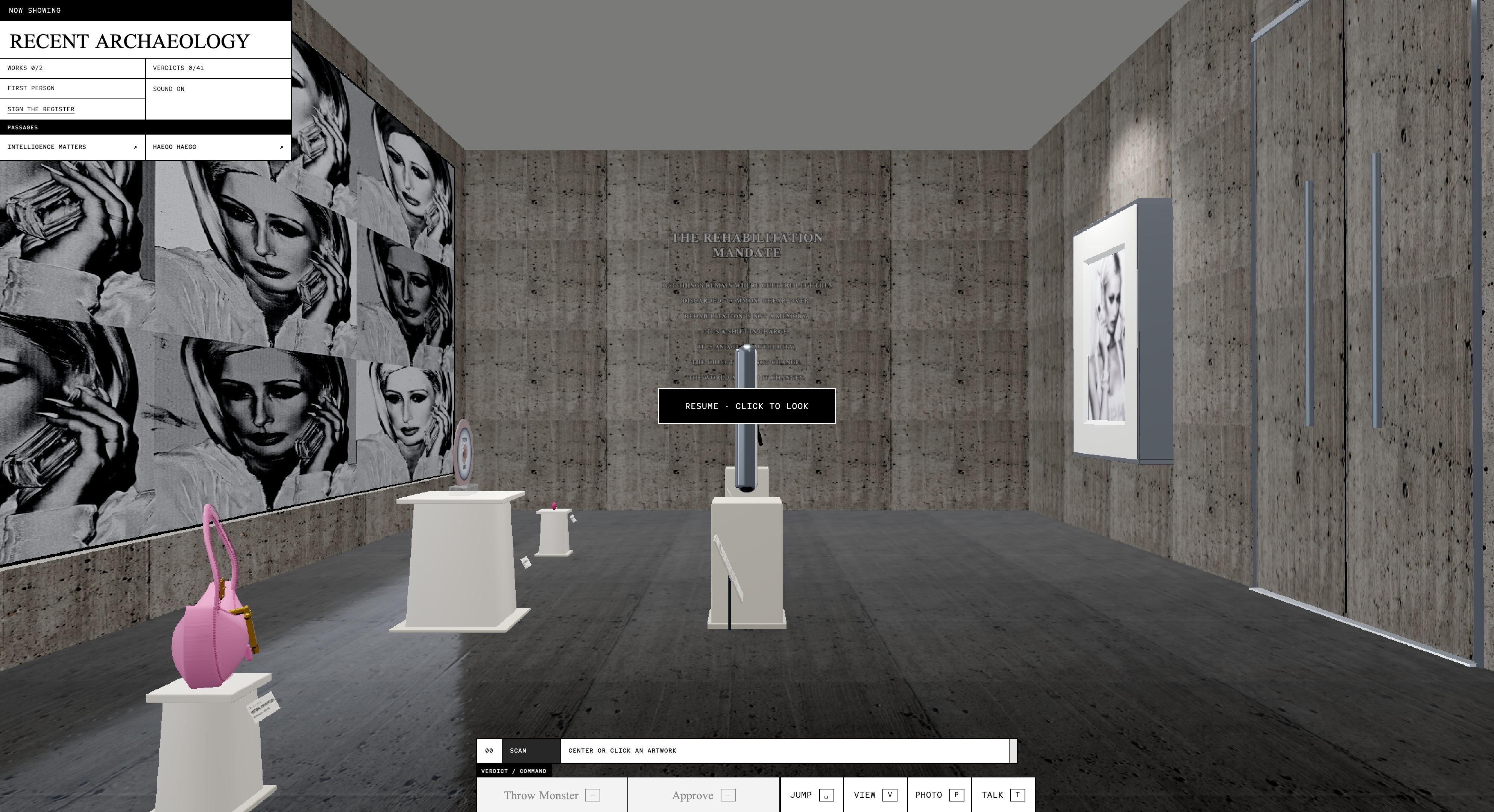
Negative Space opens RECENT ARCHAEOLOGY, a walkable room holding five digitally reconstructed consumer objects from the last pre-feed years: a handbag, an iPod, a hand-burned CD, a Tamagotchi and a Motorola RAZR. The room is open now inside Negative Space.
A new room inside Negative Space, the online art institution by Intelligence Matters. Visitors move through it in first person. Admission is free.
Five mass-market objects dated from 1997 to 2010, reconstructed at monumental scale and catalogued as evidence from a recently vanished culture.
The objects remain ordinary. The room changes the authority around them until their forgotten uses become visible.
Recent Archaeology begins one generation too early.
Nothing in the room is rare. Every specimen was manufactured in numbers large enough to disappear into daily life. Their disappearance is the material. A status handbag, a pocket music library, a writable disc, a dependent electronic organism and a hinged phone now stand on white plinths with accession numbers. The market has finished with them. The institution has only just begun.
The room recovers extinct acts, not an aesthetic. Music had to be selected, transferred and carried. A burned CD could be named by hand. A Tamagotchi asked for care without converting that care into an audience. A call ended when the phone snapped shut. Status could hang from an arm without reporting where the arm had been.
Finite machinery made its limits physical and legible: storage, battery, scratches, hinges, a library that ended. The person using it could be unavailable without turning unavailability into a setting. Innocence is not claimed.
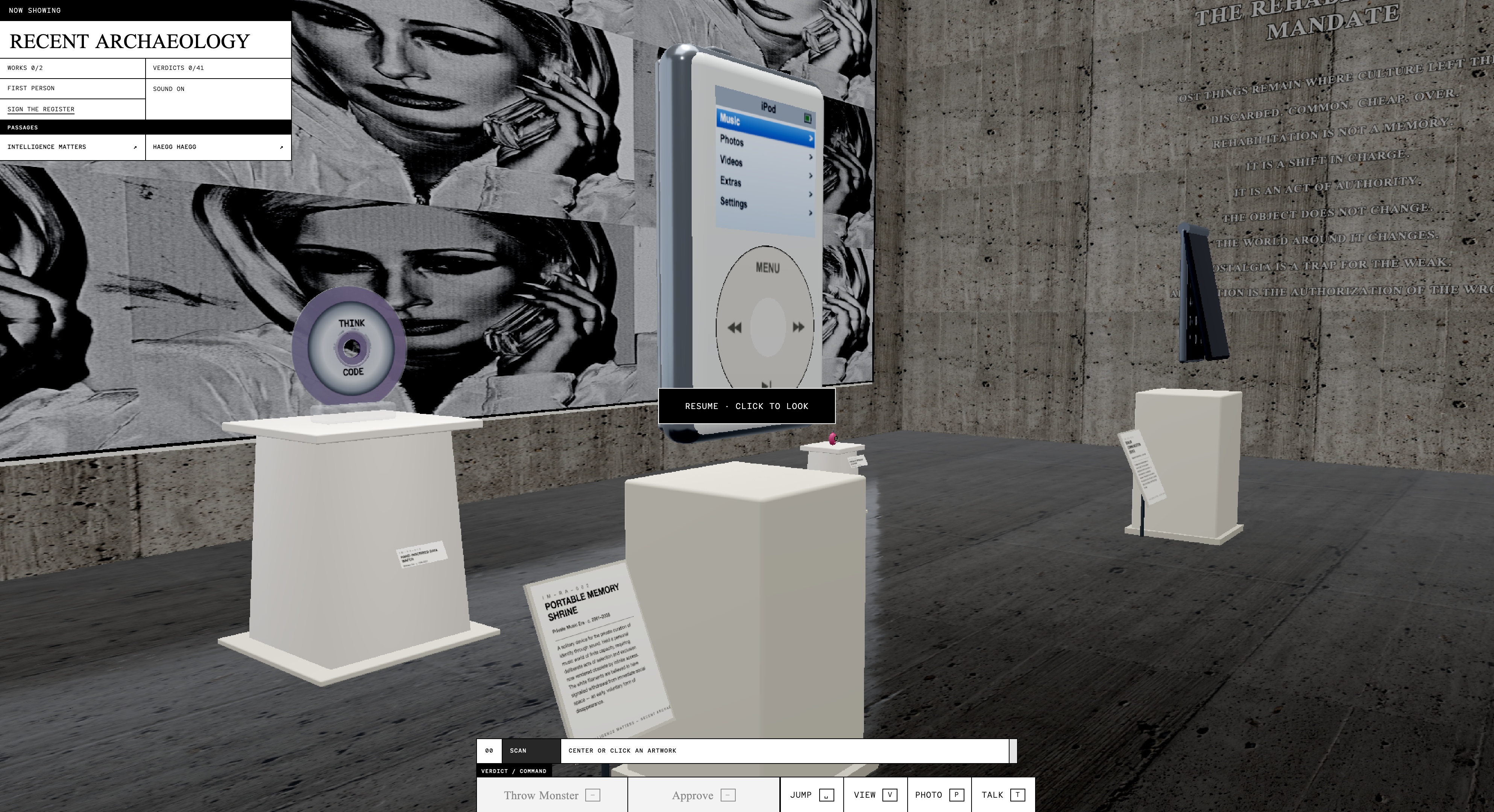
The architecture keeps the argument severe. RECENT ARCHAEOLOGY is a long chalk room with a continuous image-hang sealing the west windows. The five objects form a south-to-north sequence: pouch, music shrine and data wafer, dependent organism, bivalve terminal. At the far wall, a projector throws THE REHABILITATION MANDATE over an image of Rome.
The north wall states the mandate: “The object does not change. The world around it changes.” Nostalgia would leave the objects in the past. Authority lets them indict the present.
A museum usually receives an object after value has settled. This room receives value while it is still considered embarrassing, common or over. The distance between rubbish and relic is revealed as a lighting decision with paperwork.
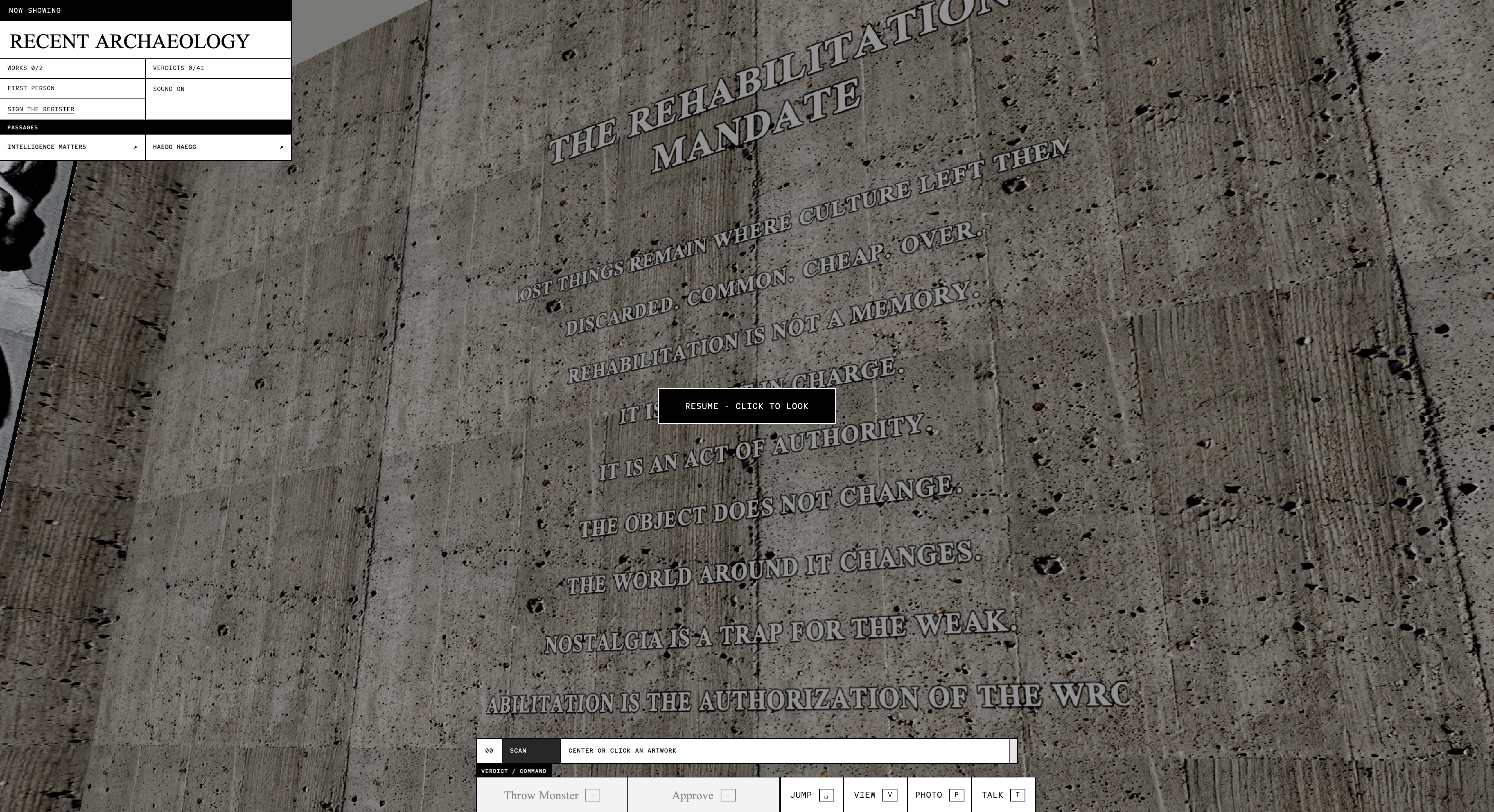
Rehabilitation is the authorization of the wrong. — THE REHABILITATION MANDATE · RECENT ARCHAEOLOGY
- RELEASE
- WIRE_2026-07-30 — IDENTITY ONCE HAD HARDWARE
- ROOM
- RECENT ARCHAEOLOGY · NEGATIVE SPACE
- STATUS
- OPEN · WALKABLE IN FIRST PERSON
- THE COUNT
- FIVE SPECIMENS · C. 1997–2010
- THE ROUTE
- STATUS → MUSIC → DATA → CARE → COMMUNICATION → AUTHORITY
- THE MATERIAL
- DIGITAL RECONSTRUCTION · CHALK · GLASS · PROJECTED LIGHT
- THE MANDATE
- THE OBJECT DOES NOT CHANGE · THE WORLD AROUND IT CHANGES
- CREATIVE
- FIVE ROOM-NATIVE STILLS CAPTURED · THREE ENTER THE RELEASE
- PUBLISHER
- JACOB HÄGG — THE ONLY PUBLISHER
Recent Archaeology is a room inside Negative Space containing five digitally reconstructed consumer objects dated c. 1997–2010. The objects are catalogued under IM–RA accession numbers and arranged on one south-to-north walk. The room ends with The Rehabilitation Mandate, projected over an image of Rome.
Negative Space is a browser-based art institution by Intelligence Matters, entered in first person. It is free to visit at negspc.intelligencematters.se.
Intelligence Matters is a creative studio working across image, design and code. Negative Space is its first public space.
Press contact. Jacob Hägg · studio@intelligencematters.se.
— 30 —